
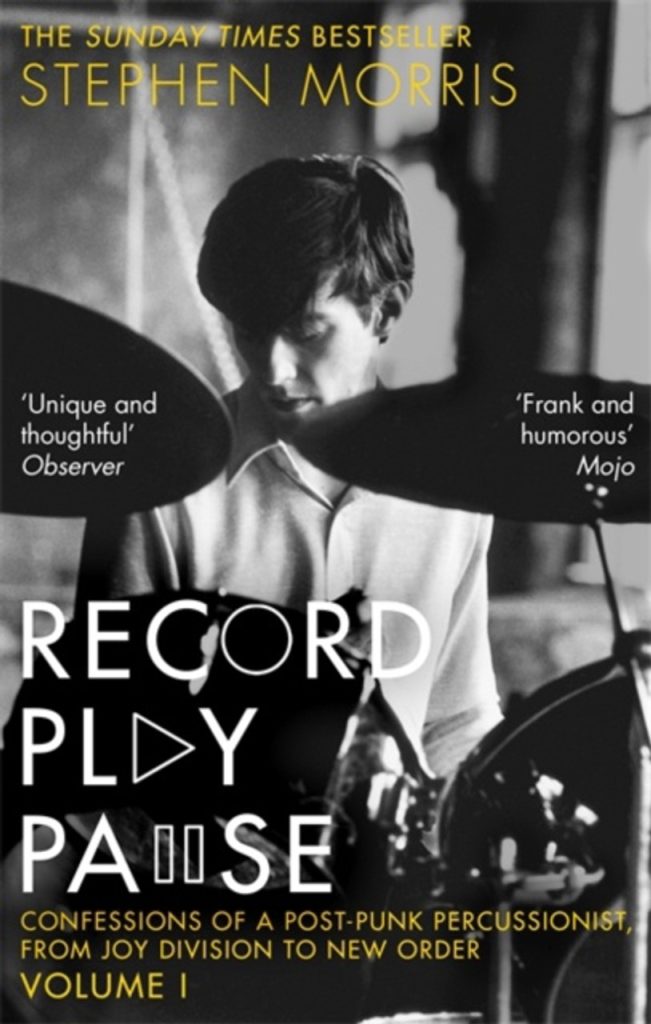
A unique and thoughtful musical memoir’ Observer ‘Gritty coming-of-age story . . . plenty of anecdotes to keep us hooked, and his memories of Joy Division’s Ian Curtis are poignant’ Daily Mirror Before he was responsible for some of the most iconic drumming in popular music, Stephen Morris grew up in 1960s and ’70s industrial Macclesfield, on a quiet road that led seemingly to nowhere. Far removed from the bright lights and manic energy of nearby Manchester, he felt stifled by suburbia and feared he might never escape. Then he joined Joy Division – while they were still known as Warsaw – a pioneer of the rousing post-punk sound that would revolutionise twentieth-century rock. Following two landmark albums and widespread critical acclaim, Joy Division were at the height of their powers and poised to break the US, when lead singer, Ian Curtis, committed suicide. Part memoir, part scrapbook and part aural Stephen Morris’s innate sense of rhythm and verve pulses through Record Play Pause . From recollections of growing up in the North West to the founding of New Order, Morris never strays far from the music. And by turns profound and wry, this book subverts the mythology and allows us to understand music’s power to define who we are and what we become.
Non Fiction Book Review: Record Play Pause
My latest obsession is Joy Division. While I was aware of the band and their album, Unknown Pleasures, for a little over 10 years, I never looked any further than this outing. I did, however, once upon a time, hop onto Discogs to have a look and see what other albums might be available on their discography. The only thing I remember was feeling a bit disappointed because, aside from Unknown Pleasures and Closer (a blind buy that I picked up on a Record Store Day in 2015), there wasn’t much in the way of their music. Sure, there were singles and compilations, but I wanted entire albums. It wasn’t until much, much, much later when I was home listening to a few albums, that I threw on Unknown Pleasures and Closer and remembered just how awesome this band was. I could not, for the life of me, wonder why they broke up. Again, I hopped onto Discogs, and it was pretty much the same… nothing. And so, I Googled, “Why did Joy Division break up?”
Oh!
That was my exact reaction when I read that lead singer Ian Curtis took his own life at such a young age. Then, I “discovered” Control, a biopic of Joy Division’s lead singer Ian Curtis. Of course, by this time, I knew that Curtis had unalived himself; even so, I wanted to know more about the band. And so, after watching Control, I went down the rabbit hole of learning (or wanting to learn) more about Ian Curtis and why he did what he did. I listened to his lyrics more intently and tried to decipher them. Of course, they could be open to interpretation, and as one might imagine, everyone can read them differently.
I tried getting my hands on more information, documentaries, live recordings of the band, and books, including this one, Record, Play, Pause, by the band’s drummer, Stephen Morris. I was looking for a “definitive” insider perspective on the band’s beginning, the music, the lyrics, and of course, Ian Curtis and his decision to no longer be. I picked up a few books, including Torn Apart, Touching From a Distance, Unknown Pleasures: Inside Joy Division, Record, Play and Pause Vol 2, and This Searing Light, the Sun and Everything Else: Joy Division: the Oral History. Yes, there are more books, but these are the ones I am starting with. I don’t know it yet, at the time of this writing, but I suspect that Deborah Curtis’ book (Ian’s wife), Touching From a Distance, may be the closest thing we will get to getting to the bottom of what may have caused him to kill himself. But, having already seen Control, on which the film is based on the book, I wanted to start elsewhere for now and then circle back to Touching.
Morris brings us along as he recounts his youth growing up in Macclesfield, England; his trials and tribulations, his love of science fiction, especially Doctor Who, and how he came to learn about music after wanting to become some sort of guitar god. That did not pan out, but in the process, he found his calling as a drummer. Reading about his journey of trying to find his place in a band was both frustrating (I would imagine) and hilarious. Given that his career would be deemed successful, having landed the job as drummer for Joy Division and then New Order, the stories were not of bitter disappointment but of accomplishment and grit.
“Joy Division would turn into such a perfect story. It’s perfect because Joy Division and lan in particular would never age. His words are there forever. He’ll never let you down.”
Stephen Morris
My initial impression of Joy Division was that they were serious musicians about their craft and a group not to be trifled with. Watching Control and reading Record Play Pause dispelled that myth; they were just a group of young people brought together by their desire to form a band and gain recognition from their contemporaries, such as the Buzzcocks. “If they can do it, so can we.” This was the sentiment that they gave off, nothing more, nothing less. However, even they, the members of Joy Division, I think, underestimated their talents, and they took the British scene by storm. Morris encapsulates this, again, by trying out different instruments and leaning toward wanting to master the drums, much to the detriment of his parents and his neighbors alike.
I thought that reading about what happened to Ian Curtis and the events that revolved around his tragic end would what would encapsulate my interest in reading this book, but I am glad to say that Curtis’ death was not the highlight of this book. It just made me realize that although the band, Joy Division, was great, these guys were not as tight as I imagined them to be, having quickly moved on from Curtis’s death. This is not to say that they didn’t care, but his death almost felt expected or even corporate (cold). Morris did express feelings of shock and awe after his death, but there was a feeling of now what and even disappointment after they were on the cusp of a North American tour that they were really looking forward to.
I did not know what to expect when going into Record Play Pause, as my only “relationship” with Joy Division is being a fan of their music. Again, I wanted to get more insight into what may have been going on in Ian Curtis’s head, but alas, it was foolish of me to think that reading a book by the band’s drummer would give me access to the brain of the ill-fated singer. It did, however, fill in one piece of the puzzle of this band, which I once deemed mysterious. At this point, I can only assume that reading other books by other band members and Deborah Curtis will help paint a complete picture, or at least close to a complete one.