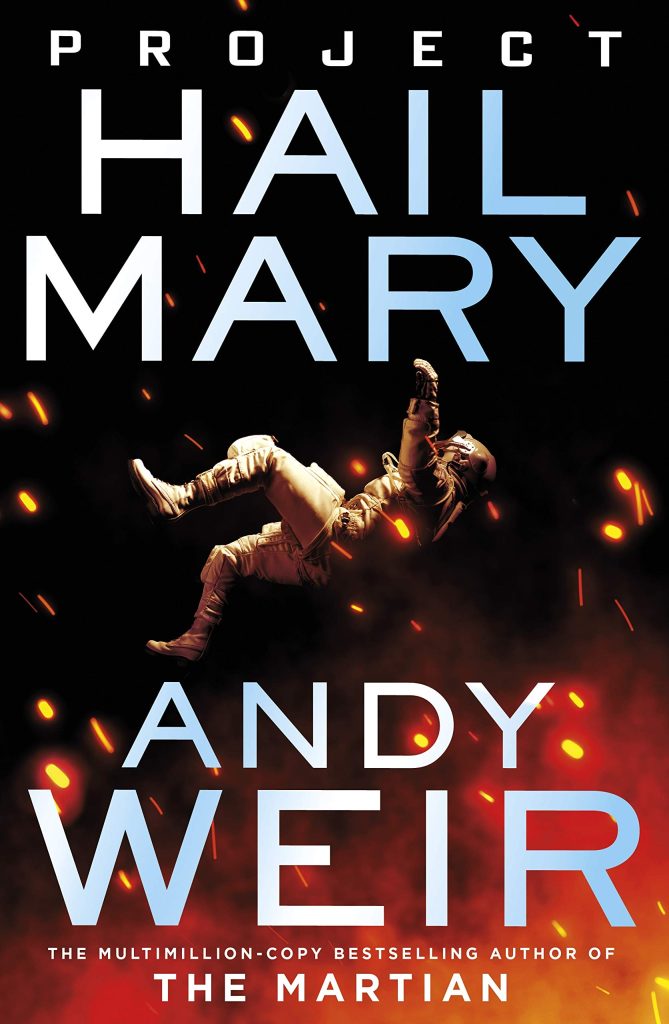
Ryland Grace is the sole survivor on a desperate, last-chance mission—and if he fails, humanity and Earth itself will perish.
Except that right now, he doesn’t know that. He can’t even remember his own name, let alone the nature of his assignment or how to complete it.
All he knows is that he’s been asleep for a very, very long time. And he’s just been awakened to find himself millions of miles from home, with nothing but two corpses for company.
His crewmates dead, his memories fuzzily returning, Ryland realizes that an impossible task now confronts him. Hurtling through space on this tiny ship, it’s up to him to puzzle out an impossible scientific mystery—and conquer an extinction-level threat to our species.
And with the clock ticking down and the nearest human being light-years away, he’s got to do it all alone.
Or does he?
Science Fiction Book Review: Project Hail Mary
After I finished reading Arthur C. Clarke’s Childhood’s End, I was in no hurry to read another science fiction novel. While I enjoyed reading the book, it didn’t leave me yearning for more. If I am being honest, it slightly put me off reading science fiction. This is no knock to Clarke, but there was something about Childhood’s End that didn’t quite do it for me. It wasn’t as impactful as I had hoped it would be so I reverted to one of my go-to genres, horror. It wasn’t until about a month or two when my brother’s girlfriend recommended I give Project Hail Mary by Andy Weir a read. She highly recommended the audiobook version as the narrator, Ray Porter, was fantastic, and since I like to both read and listen (on my commute to work), I purchased both the hardcover book and the audiobook.
I would always see this book displayed in my local Barnes & Noble as I swiftly walked past it to the record and bluray section hoping that there would be a few things on clearance which just means that they would be regular price here. Then, about a few months ago, I saw the movie trailer for the book’s adaptation to the big screen starring Ryan Gosling. It never captured my interest then and still doesn’t capture my interest after being recommended to me. “Nah, I’m good. I’m not really into reading science fiction,” is my template response. Still, I indulged and purchased the book, nonetheless. I figured I’d read the book prior to watching the movie when it’s released next year. And so, it sat on my bookshelf… and sat…sat some more until finally, I said, what he hell and picked it up.
I didn’t know much about the plot nor the author other than he is responsible for writing The Martian, which got critical acclaim. I didn’t read the book, but I did see the movie, and I could not remember it well. I remember a lot of math and science and, while fascinating, I didn’t want to watch a movie and learn about how I could survive being stranded on Mars should that unlikely scenario ever surface. Again, a fascinating premise, but I did not see myself reading a novel of 300+ pages on what the protagonist needs to do to get back home, to Earth, alive. Maybe if it were 150-200 pages, then OK, I may have read it, but it just felt too long of a read. After watching the movie, my suspicions were correct in thinking that The Martian would have been a boring read. Was the movie boring – yes and no. Again, the idea of being stranded on Mars is both interesting and terrifying, but it also teetered on the fantastical (at least today). The way it’s written by both the author, Weir, and the screenwriter, Drew Goddard made me believe everything was real and brought me over from the “realm of possibility” to actually believing that it is absolutely possible to survive Mars and make it back home with only emotional scars that will haunt him until the day he dies. So, here I was with Project Hail Mary in my hands. I took a deep breath and began my journey into the mind of Andy Weir.
I went into Project Hail Mary with an idea of what to expect, and I got exactly what was anticipated: lots and lots of math and science. While this was a bit cumbersome, I appreciated the massive data and information dump because Weir allowed me to suspend belief with the idea that the narrative had actual science backing it. Whether the science presented in the book was real or not, I didn’t care because it was so convincing that I took it at face value. Weir’s writing, it would seem, has a tendency to do that — bury you with so much jargon that perhaps only a scientist can dispute any of the claims made in the book. I suppose I could have done the same, but where would the fun be in doing that?
The story engrossed me: a team must save the Earth because our sun is dying. Great, I thought, it’s Sunshine. Although sounding similar, it is anything but. Ryland Grace, our protagonist, tells the story non-linearly having a bout of amnesia, throwing us into his reality in space and feeding us snippets of his past to reveal how he reached his present situation. We are along for the ride with Ryland as we too try to figure out what is happening, only we, the audience (not I), do not have the expertise or know-how on how to proceed with this mission. “Coincidences” and plot devices often appear in Weir’s works to advance the story, regardless of how absurd they seem. When Ryland was in an impossible situation, he would remember an old memory or there would just so happen to be something to fix that exact problem – of course, I would whisper to myself. I also felt that there was too much humor in the narrative where, in reality, one would panick in fear. I didn’t get much of that from Ryland, and if it was there, it was only present briefly and disguised with humor. Sorry, but there was more than one instance where I would never find humor no matter how hard I tried.
Despite my gripes with some of the writing and plot devices, as well as the plethora of science and mathematics which could make the read tedious, tiresome and redundant, I could not help but enjoy the reading as done by Ray Porter; he made the audio version of Project Hail Mary far more enjoyable than having read it on my own. He brought the characters to life. Coming from my first sci-fi read, Childhood’s End, Project Hail Mary was a breath of fresh air where Weir was able to infuse science, math, humor, horror, suspense and drama. Childhood’s End was drab in comparison. This is a modern science fiction of the times where, without humor, action sequences and suspense it might fail to keep the attention of its readers. It is a double-edged sword because, take away a few of these characteristics and Project Hail Mary might fall into the science fiction abyss of obscurity. Thankfully, this is not Project Hail Mary.