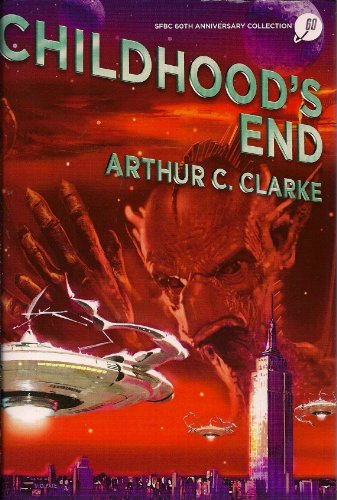
The Overlords appeared suddenly over every city—intellectually, technologically, and militarily superior to humankind. Benevolent, they made few demands: unify earth, eliminate poverty, and end war. With little rebellion, humankind agreed, and a golden age began.
But at what cost? With the advent of peace, man ceases to strive for creative greatness, and a malaise settles over the human race. To those who resist, it becomes evident that the Overlords have an agenda of their own. As civilization approaches the crossroads, will the Overlords spell the end for humankind . . . or the beginning?
Science Fiction Book Review: Childhood’s End
I’ve been a fan of science fiction since being a kid and first watched Return of the Jedi in a dingy old movie theater in the summer of 1983. Would you believe I was three years old at the time? I don’t remember much of the film’s plot and storyline but what i do remember is bright yellow sand and a green laser thing. Fast forward a couple of years and my dad made a VHS copy of the film and I was able to relive that experience in all it’s full analog glory. That was a pivotal moment in my life as Star Wars had become somewhat of a big-ish thing in my life. Am I obsessed? Absolutely not! However, the story that George Lucas wove together holds a very special place in my heart. It became my first foray into the world of science fiction and then became a staple living inside my VCR. From watching the original Star Wars Trilogy every Christmas on the USA Network to sitting with my dad to watch The Twilight Zone marathon until we had to get up to watch the ball drop and celebrate with the rest of the family, you know, like everyone in the East Coast was doing, science fiction was an integral part of my youth and growing up.
What I was not a fan of was reading science fiction. The thought of having to learn otherworldly names and non-existent planets deterred me. A fear of brain overload, I deduced. But, I can finally say that in the year 2025 A.D. I caved and purchased my first sci-fi novel. I can’t say why I purchased Arthur C. Clarke’s Childhood’s End to be my first foray into the literary world of science fiction as anyone who knows me would assume that I would have gone with something that leaned more towards the horror/sci-fi spectrum, ala Alien or Event Horizon. More likely, it was the “buzz” that Childhood’s End garnered on the “interwebs” where there were many-a-fan praising the author and his work. I knew of Arthur C. Clarke because people adapted his work for the big screen, including Stanley Kubrik’s 2001: A Space Odyssey and its follow-up film, 2010: The Year We Make Contact. I remember first seeing 2001 as a teenager and being both baffled and amazed by both the story and the visuals. Still, it was not enough to convince me to pick up a science fiction novel by said author or anyone else for that matter. At the time, 2001 was confusing and even to this day I find myself questioning the events of the film even though I have a better grasp to its meaning… I think.
My best friend, however, is an adamant fan of science fiction films, television and literature. We would often compare notes on a Christopher Nolan film or the latest episode of Battlestar Galactica (2004 reboot). We would salivate and gush after having watched an episode and come up with theories of the show’s endgame (I am proud to say that I called what would happen at the series’ conclusion). He would constantly recommend novels for me to read, but I was stubborn and kept rejecting those recommendations. But eventually I was ready to start reading science fiction and asked him where I should start. He listed a plethora of books and authors and so, like a buffoon, I didn’t go with any of his recommendations – they sounded all too complicated. I wanted to start with something proclaimed and easy to read and landed on Childhood’s End.
The story was simple, and like many sci-fi movies, “contact” is made by way of a glorious and dramatic reveal in the heavens. The Overlords show up unannounced for all the world to see, gasp and count their blessings. They do not immediately reveal themselves as they bide their time for humans to get used to the idea of their arrival (invasion?) before making an appearance. When they do, it gives the humans another reason to pause and question even more of our purpose and being and their reason for coming to Earth. There is a long game but, as one might expect, their purpose is not reveled until the tail end of the novel. The Overlords, however, come bearing gifts in the form of new technology and world peace – a new golden age, so to speak. But, as one night expect, it comes at a hefty price that humanity will have to pay.
Science is the only religion of mankind.
― Arthur C. Clarke, Childhood’s End
Clarke’s Childhood’s End inhibited a plethora of feelings and is certainly thought-provoking. I had to let this one sit in my head for a while before I could fully process what I read. Growing up in a catholic household I could not but help but to draw religious parallels with the Overlords and the Overmind, a god and its minions, whether they be angels or demons. Here, they are aliens but can be construed as religious beings to some. Much like the 2009 film, Knowing, Childhood’s End opens the floor for questions of the narrative’s intended purpose as it is a fascinating and interesting read. It is a great book for discussion, perhaps in a book club to get further insight as to what Clarke’s intended message may have been. This is not to say that this book is religious in anyway but, again, there is some food for thought presented and these other-worldly beings make us look at ourselves as a species and ponder the very being of our existence. Being that Childhood’s End is the first science fiction book that I have read, it has set a bar – whether that is a good thing or a bad thing, only time will tell until I read my next science fiction book.